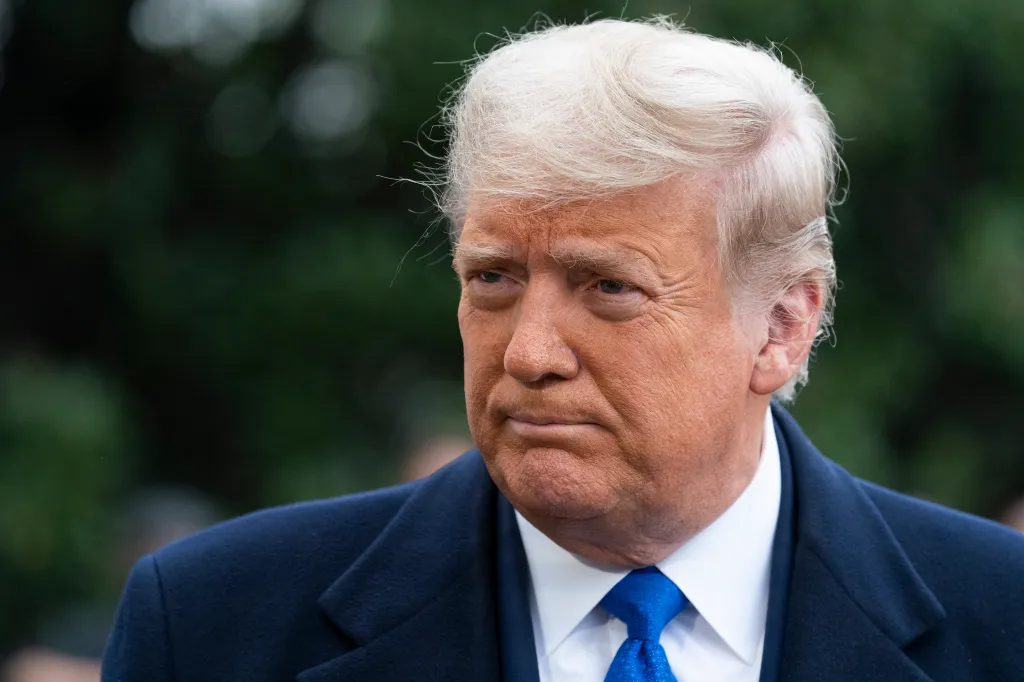
NEW YORK (AP) — An appeals court on Thursday overturned the hefty civil fraud penalty imposed on President Donald Trump in a New York state ruling, accusing him of exaggerating his wealth.
The decision came seven months after the Republican president returned to the White House. A five-judge panel of the New York Intermediate Court of Appeals called the ruling, which was expected to cost Trump more than $515 million and dent his real estate empire, “excessive.”
After Trump was convicted of fraud for blatantly manipulating financial statements submitted to lenders and insurance companies, Judge Arthur Engoron last year ordered him to pay $355 million in fines. With interest, the total amount exceeded $515 million.
These fines, plus those imposed on other Trump Organization executives, including his sons, Eric and Donald Jr., totaled $527 million, including interest.
Although the court-ordered injunction was carefully crafted to curb the defendants’ corporate culture, the rescission order, which required the defendants to pay nearly half a billion dollars to the state of New York, constituted an excessive fine and violated the Eighth Amendment to the U.S. Constitution, wrote Judges Diane T. Renwick and Peter H. Moulton in one of several opinions that guided the appeals court’s decision.
Ingoron also imposed other sanctions, including a ban on Trump and his two eldest sons from holding corporate leadership positions for several years. These sanctions were temporarily suspended pending Trump’s appeal, and he was able to defer collection of his bail by paying $175 million.
The court, divided on the merits of the case and the lower court’s finding of fraud, overturned Ingoron’s sentence in its entirety, leaving the door open for further appeals to the state’s highest court, the Court of Appeals.
The Court of Appeals, the appellate division of the state’s lower court, took an unusually long time to decide Trump’s appeal, reviewing it for nearly 11 months after oral arguments last fall. Appeals are typically resolved within weeks or months.
New York Attorney General Letitia James, who brought the case on behalf of the state, said the businessman-turned-politician was guilty of “egregious lies, cheating, and fraud.” Her office did not immediately comment on Thursday’s ruling.
Trump and the other defendants have denied any wrongdoing. In a brief six-minute summary delivered after a months-long trial, Trump declared in January 2024 that he was an “innocent man” and that the case was a “fraud against him.” He repeatedly claimed that the case and the verdict were politically motivated actions by James and Engoron, both Democrats.
The Trump Justice Department subpoenaed James to produce documents related to the trial, among other things, as part of an investigation into whether it violated the president’s civil rights. James’s personal lawyer, Abe D. Lowell, said the fraud investigation “is the most egregious and desperate example of this administration’s campaign of political revenge against the president.”
Trump and his lawyers argued that his financial statements were not misleading because they came with disclaimers stating they were unaudited. The defense also pointed out that bankers and insurance companies independently evaluated the figures and that the loans had been repaid.
Despite some inconsistencies, such as the tripling of the square footage of his Trump Tower apartment, Trump claimed that the financial statements were, if not substantially, underestimates of his wealth.
At an appeals hearing in September, Trump’s lawyers argued that many of the allegations in the case were outdated, a claim they unsuccessfully challenged before trial. The defense also alleges that James abused consumer protection law to sue Trump and mismanaged private business transactions that favored those involved.
Prosecutors said the law applies to fraudulent or illegal business practices, whether targeting ordinary consumers or large corporations. Despite Trump’s insistence that the financial data harmed no one, the state maintains that the figures prompted lenders to make riskier loans than intended, and that honest borrowers lose when others manipulate their wealth figures.
The state argued that the sentence was based on sufficient evidence and that the penalty amount was consistent with Trump’s gains, including profits from real estate financed by the loans and interest saved by securing favorable terms for wealthy borrowers.
The civil fraud case was one of many legal hurdles Trump faced during his campaign, victory, and transition to a second term.
On January 10, he was sentenced to conditional discharge in the criminal bribery case, which keeps his conviction in effect but spares him prison time, probation, fines, or any other penalty. He has appealed this sentence.
In December, a federal appeals court upheld the jury’s verdict that Trump sexually assaulted author E. Jean Carroll in the mid-1990s and subsequently defamed her, upholding a $5 million judgment. In June, the appeals court declined to review the case; he can still try to convince the Supreme Court to consider his appeal.
He also appealed a subsequent ruling ordering him to pay Carroll $83.3 million for additional defamation charges.