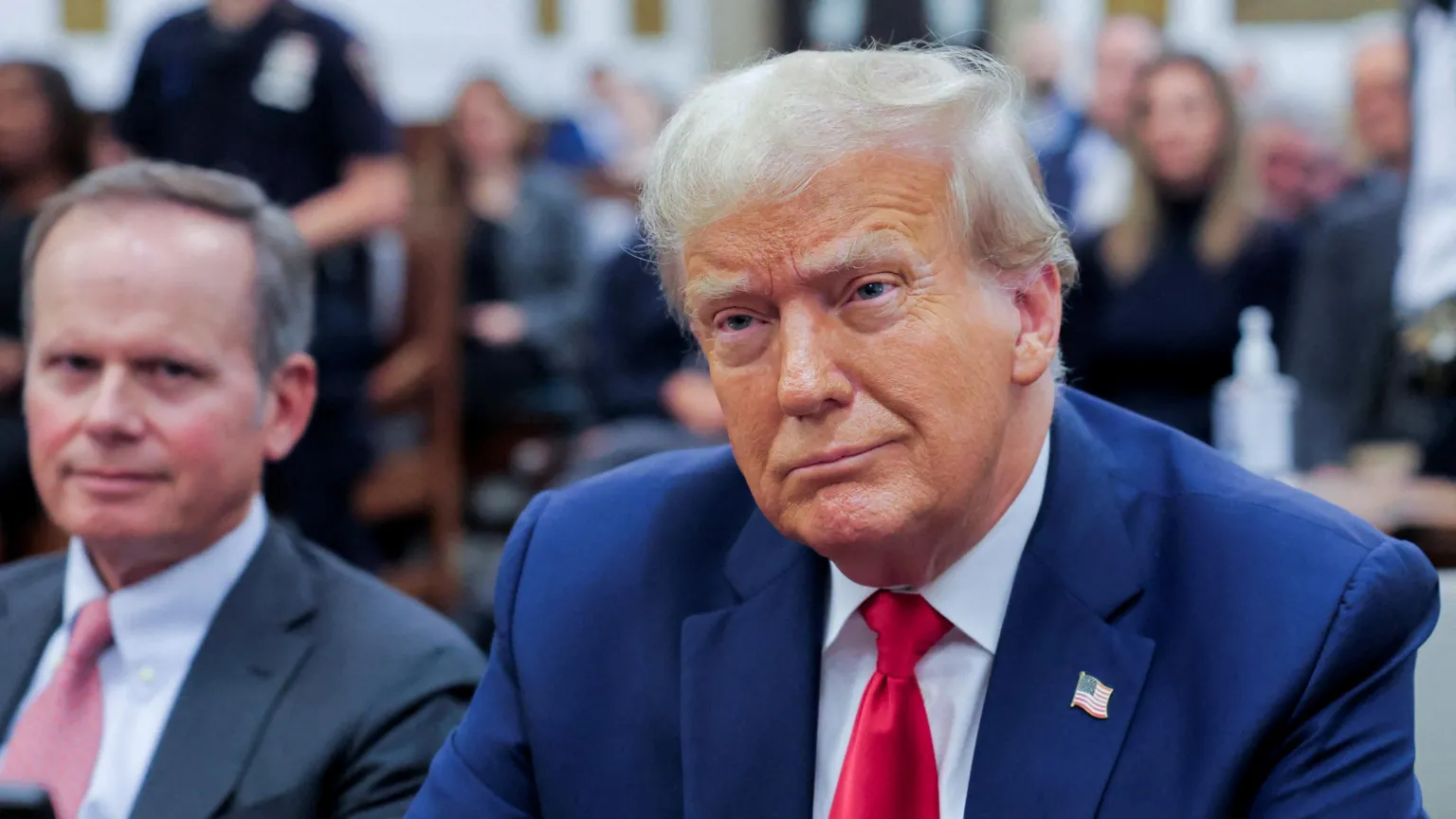
An appeals court has rejected the $500 million (£372 million) fine President Donald Trump was ordered to pay in a civil fraud trial in New York last year.
Judge Arthur Engoron had ordered Trump to pay the costs associated with grossly overvaluing Trump Organization properties to secure favorable loans.
In a lengthy ruling issued Thursday, the New York Supreme Court’s Appellate Division judges ruled that, while Trump was responsible for the fraud, the nearly half-billion-dollar fine was excessive and may have violated constitutional protections against harsh penalties.
In that case, Judge Engoron ordered Trump to pay $355 million, but with interest, the amount rose to more than $500 million.
Judge Peter Moulton wrote: “While harm was certainly caused, it was not catastrophic harm that would justify nearly half a billion dollars in damages for the State.”
In a post on his social media platform, Truth Social, Trump called the decision a “total victory.”
He said: “I deeply appreciate the courage the court showed in rejecting this illegal and shameful decision that harmed businesses across New York.” He added: “This was a politically charged and commercially vicious campaign, without precedent.”
The New York Attorney General’s office, which filed the lawsuit against Trump, also portrayed the decision as a victory because it upheld Trump’s liability for the fraud, and the judges did not waive any other non-monetary penalties. The office intends to appeal the fine to the state’s highest court, the Court of Appeals.
In a statement, the Attorney General’s Office said the judges “upheld the correctness of the lower court’s conclusion: Donald Trump, his company, and two of his sons are liable for the fraud.”
It added, “This history should not be forgotten: another court ruled that the president violated the law, and our case stands.”
In the case against Trump, his two adult sons, and the Trump Organization, Judge Engoron also barred Trump from serving as a corporate director and from receiving loans from state-owned banks for three years.
Thursday’s decision upheld these sanctions, along with other non-monetary sanctions imposed by Judge Engoron.
The 323-page decision, which included three lengthy opinions, revealed disagreement among the panel’s five judges.
The judges were primarily divided on the merits of the original complaint filed by Letitia James, which accused Trump and his sons of “continuous and repeated fraud.”
While several justices stated that she was “well within her legal authority in bringing this action,” one held that the case should have been dismissed, while two held that a new, narrower trial should be held.
However, these two justices joined in overturning the fine “for the sole purpose of ensuring its resolution,” wrote Judge Moulton.
Judge Moulton also wrote that American voters “have rendered a clear judgment” on Trump’s political career, and that “today, this Court unanimously blocks efforts to destroy his business.”
The decision came nearly a year after the commission heard oral arguments on appeal, during which several judges expressed skepticism about the civil fraud case.
Trump’s son, Eric Trump, who is involved in the case, praised the decision in a social media post.
He wrote: “After five years of suffering, justice has prevailed!”
Will Thomas, an assistant professor of business law at the University of Michigan, said the decision resembled “a judicial version of deferred judgment.”
He said: “By their own admission, the appellate courts are deferring the actual legal decision to the New York Court of Appeals, claiming that their unusual decision was made ‘for the sole purpose of ensuring a fair trial.'”
It’s difficult to draw any conclusions from this case… except that we will have to wait a long time to know the final outcome of James v. Trump.
In September 2023, Judge Engoron found Trump liable for corporate fraud, finding that he had falsified his wealth to the tune of several hundred million dollars. A second trial is scheduled for 2024 to determine punishment.
In one case, a judge found that Mr. Trump’s financial statements falsely stated that his Trump Tower penthouse was nearly three times its actual size.
Trump said the lawsuit filed by James, a Democrat, was politically motivated.
Mark Zuderer, a veteran appellate lawyer in New York, said Thursday’s unusually long ruling also reflected the historic impasse over how to handle a massive fraud case involving a sitting president.
Mr. Zuderer asked, “Would you have a 300-page opinion if this were about businessman Joe Smith, not Donald Trump?”